Flying Wind Mill
Team at Altaeros Energies uses this idea as their base and use helium gas to fill the tube shaoed balloon to lift the turbine off the ground to a height where wind currents are stronger.ButHow the turbine would remain still above the ground?.To this Engineers at Altareos Energies explains that the wind turbine will be held steady by making use of strong tethers which will also transfer the electricity generated to ground. Readmore...
Underwater Welding
The fact that electric arc could operate was known for over a 100 years. The first ever underwater welding was carried out by British Admiralty – Dockyard for sealing leaking ship rivets below the water line. Underwater welding is an important tool for underwater fabrication works. In 1946, special waterproof electrodes were developed in Holland by ‘Van der Willingen’. Readmore..
Epson Moverio
Epson Moverio was supposedly meant to be used as a video reviewing device for personal use.The developers at APX Labs, it seems, are fan of making crosses . So when this Epson Moverio got into their hands they saw an opportunity and seized it. Readmore...
No mechanic needed....

5G NETWORK

MEST hopes to have a trial 5G service ready by 2017 and make the technology commercially available by 2020. The ministry also aims on developing new features alongside the network itself, including Ultra-HD streaming, hologram transmission and upgraded social networking services. The government estimates that the projected sales for relevant industries using the 5G infrastructure between 2020 and 2026 will be $310 billion (331 trillion won.
Bending glass

Mechanical Engineers have always been advance and innovative than any other discipline and here's one of another invention-A Glass that bends but doesn't break
Normally when you drop a drinking glass on the floor it shatters. But, in future, thanks to a technique developed in McGill's Department of Mechanical Engineering, when the same thing happens the glass is likely to simply bend and become slightly deformed. That's because Prof. François Barthelat and his team have successfully taken inspiration from the mechanics of natural structures like seashells in order to significantly increase the toughness of glass.
"Mollusk shells are made up of about 95 per cent chalk, which is very brittle in its pure form," says Barthelat. "But nacre, or mother-of-pearl, which coats the inner shells, is made up of microscopic tablets that are a bit like miniature Lego building blocks, is known to be extremely strong and tough, which is why people have been studying its structure for the past twenty years."
Previous attempts to recreate the structures of nacre have proved to be challenging, according to Barthelat. "Imagine trying to build a Lego wall with microscopic building blocks. It's not the easiest thing in the world." Instead, what he and his team chose to do was to study the internal 'weak' boundaries or edges to be found in natural materials like nacre and then use lasers to engrave networks of 3D micro-cracks in glass slides in order to create similar weak boundaries. The results were dramatic. The researchers were able to increase the toughness of glass slides (the kind of glass rectangles that get put under microscopes) 200 times compared to non-engraved slides. By engraving networks of micro-cracks in configurations of wavy lines in shapes similar to the wavy edges of pieces in a jigsaw puzzle in the surface of borosilicate glass, they were able to stop the cracks from propagating and becoming larger. They then filled these micro-cracks with polyurethane, although according to Barthelat, this second process is not essential since the patterns of micro-cracks in themselves are sufficient to stop the glass from shattering.
The researchers worked with glass slides simply because they were accessible, but Barthelat believes that the process will be very easy to scale up to any size of glass sheet, since people are already engraving logos and patterns on glass panels. He and his team are excited about the work that lies ahead for them. "What we know now is that we can toughen glass, or other materials, by using patterns of micro-cracks to guide larger cracks, and in the process absorb the energy from an impact," says Barthelat. "We chose to work with glass because we wanted to work with the archetypal brittle material. But we plan to go on to work with ceramics and polymers in future. Observing the natural world can clearly lead to improved man-made designs."
RAILGUN- A 21st century weapon
- Gunpowder must be carried with the projectile, making the entire round heavier.
- Ordnance based on black powder is volatile, and so difficult to handle and transport.
- The muzzle velocity of projectiles propelled by gunpowder is generally limited to about 4,000 feet (about 1,219 meters) per second.
- The power supply is simply a source of electric current. Typically, the current used in medium- to large-caliber rail guns is in the millions of amps.
- The rails are lengths of conductive metal, such as copper. They can range from four to 30 feet (9 meters) long.
- The armature bridges the gap between the rails. It can be a solid piece of conductive metal or a conductive sabot -- a carrier that houses a dart or other projectile.


fastest maglev trains

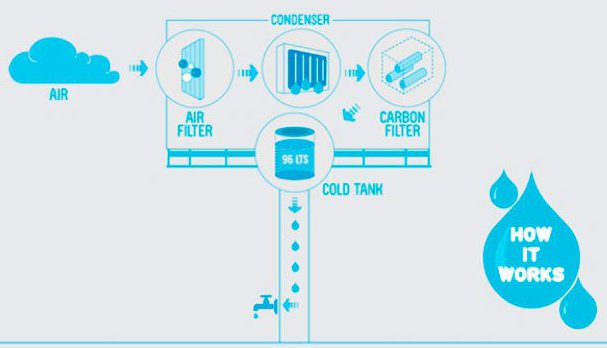
Billboard producing drinking water from Air
Autonomous Robot Assemble itself and Fly!!!!!

Project zero-first Helicopter +Plane..
Zero Blade Wind Mill

Wind power is one of the technologies the world is counting on to provide a source of sustainable, non-polluting energy. Wind is abundant, totally clean, and perpetually renewable and unlike fossil reserves, it is widely distributed across the five continents. Shifting to renewable energy (including wind energy) is becoming a must to address the climate change challenge.
A Tunisian start-up company named Saphon Energy has brought a new concept to the market. The key idea here is to create a turbine, windless, for generating electricity from the wind. Uh, wait, a windless turbine to create energy from the wind? Yeah, a bit confusing, but stay with us
Solar power Quadcopter

Fly with your bikes

Underwater welding

Underwater welding is an important tool for underwater fabrication works. In 1946, special waterproof electrodes were developed in Holland by ‘Van der Willingen’. In recent years the number of offshore structures including oil drilling rigs, pipelines, platforms are being installed significantly. Some of these structures will experience failures of its elements during normal usage and during unpredicted occurrences
Liquid metal battery

CardBoard Bicycle for $30

Flying wind mill
The i3,BMW electric car Revealed

Take telescope pics with Your SmartPhones!!!
ERA-Environment Responsible Aviation
Nasa 3-D Printed rocket Engine Ejector